In Construction and Infrastructure, compressed air is often called the lifeblood of the job site. Unlike indoor factory installations, air compressors in this sector must handle harsh environments, heavy dust, extreme weather, and constant relocation.
Depending on whether the project is mobile field work or a fixed infrastructure plant, the setup and machinery differ significantly.
1. Portable vs. Stationary Rotary Screw Compressors
A. Portable Diesel-Driven Rotary Screw Compressors
-
Primary Use: Road building, bridge repair, trenching, utility maintenance, and remote construction sites without stable electrical power.
-
Key Features:
-
Diesel Engine Driven: Integrated with reliable diesel engines (e.g., Cummins, Caterpillar, Yanmar) meeting local emissions standards.
-
Towable / Skid-Mounted: Built on rugged heavy-duty chassis with tires, towbars, and protective canopies for transport over rough terrain.
-
Weather & Dust Proof: Heavy-duty enclosure, reinforced steel frame, and dual-stage air intake filters to protect the engine and compressor element from ambient dust.
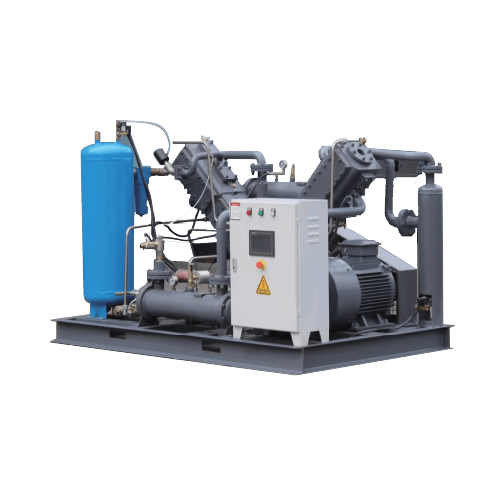
B. Stationary Electric Rotary Screw Compressors
-
Primary Use: Precast concrete manufacturing plants, asphalt plants, tunnel construction sites (where diesel exhaust is restricted), and long-term infrastructure mega-projects.
-
Key Features:
-
Electric Motor Driven: More cost-effective per $\text{m}^3$ of air produced when grid power or heavy industrial generators are available.
-
High-Efficiency Air Delivery: Often paired with Variable Speed Drives (VSD) or Two-Stage compression to manage fluctuating plant demands.
2. Core Applications on Construction Sites
-
Demolition & Breaking: Powering heavy pneumatic jackhammers, breakers, rock drills, and chipping hammers.
-
Trenchless & Foundation Drilling: Driving directional drilling rigs, piling equipment, and rotary hammer drills.
-
Concrete & Shotcrete: Pneumatic spraying of concrete (shotcreting) for tunnel linings, slope stabilization, and retaining walls.
-
Abrasive Blasting & Painting: Sandblasting or grit blasting steel girders, bridge structures, and rebar prior to protective coating.
-
Pneumatic Tool Operation: Powering impact wrenches, nailers, and clamping devices for structural steel and timber assembly.
-
Pipe Testing & Cleaning: High-pressure line purging, pressure testing of gas/water pipelines, and cable blowing in telecom conduits.
3. Key Operating Requirements for Construction
-
Air Quality & Aftercooling:
-
Compressed air leaves the screw element at elevated temperatures and saturated with moisture.
-
Built-in Aftercoolers & Water Separators: Essential for blasting and drilling to prevent wet air from clogging sand nozzles or rusting internal hammer valves.
-
Durability & Maintenance:
Summary Checklist for Infrastructure Projects
| Parameter |
Portable / Field Construction |
Fixed / Precast / Tunnel Infrastructure |
| Power Source |
Diesel Engine (Towable/Skid) |
Electric Motor (Grid/GenSet) |
| Pressure Range |
$7\text{ to }25\text{ bar}$ ($100\text{ to }360\text{ psi}$) |
$8\text{ to }13\text{ bar}$ ($115\text{ to }190\text{ psi}$) |
| Enclosure |
Weatherproof, sound-damped canopy |
Standard industrial cabinet / IP54 |
| Primary Goal |
Mobility, high durability, versatile pressure |
Continuous air flow, low operating cost, low noise |