In the automotive industry, air compressors are critical utilities. However, the requirements for Automotive Repair Shops (Body Shops & Service Centers) and Automotive OEM Manufacturing Plants differ significantly in scale, air quality, and equipment choices.
1. Automotive Repair & Body Shops
Automotive repair centers demand reliable, quiet, and clean air to power air tools, tire changers, and professional paint booths.
Key Applications
-
Air Tools & Impact Wrenches: Powering pneumatic ratchets, tire changers, and lift controls.
-
Paint Spray Booths: Delivering clean, dry air for smooth paint finishing without fisheyes, blisters, or defects.
-
Sanding & Surface Prep: Continuous airflow for orbital sanders and body surface preparation.
Recommended Setup
-
Compressor Type: Rotary screw compressor (typically 7.5 HP to 30 HP / 5.5 kW to 22 kW). Rotary screws are preferred over reciprocating piston models because they operate quietly ($\approx 62\text{–}68\text{ dBA}$) and run continuously without overheating.
-
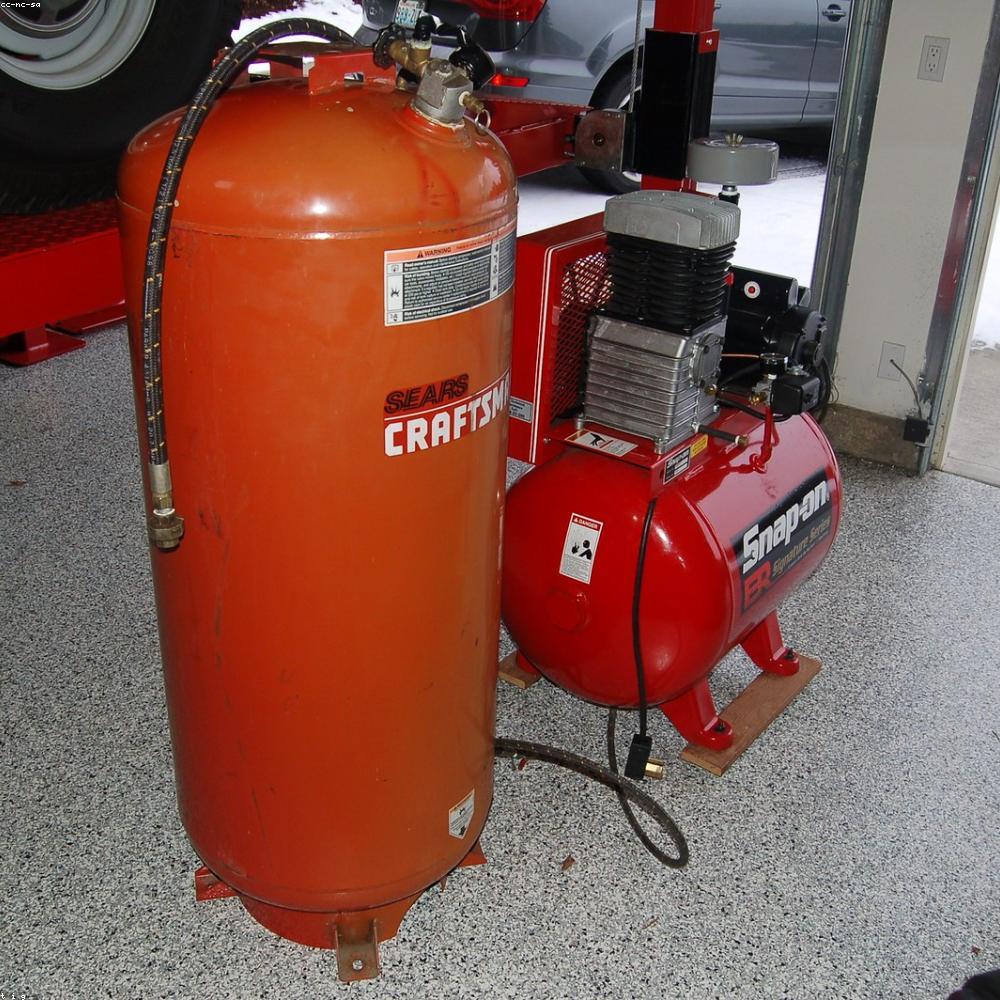
Tank-Mounted / All-In-One Units: Integrated packages featuring the compressor, air receiver tank, and refrigerated air dryer on a single skid. This design saves floor space in service bays.
-
Essential Downstream Equipment:
-
Refrigerated Air Dryer: Prevents water moisture from ruining air tools or mixing into paint lines.
-
Coalescing Filters (0.01 micron): Essential for paint booths to eliminate oil aerosols and tiny particles.
2. Automotive Manufacturing Plants
Automotive assembly plants require large-scale, continuous compressed air systems designed for 24/7 operation and high energy efficiency.
Key Applications
-
Robotics & Automated Assembly: Pneumatic cylinders, grippers, clamping systems, and spot-welding robots.
-
Stamping & Metal Fabrication: High-force air valves, sheet metal handling, and laser/plasma cutting assist gas.
-
Automated Paint Lines (E-Coat & Topcoat): Ultra-clean air for robotic sprayers and finish lines where any oil or particulate contamination will cause million-dollar rework costs.
-
Tire Mounting & Leak Testing: High-volume inflation and pressure testing on assembly lines.
Recommended Setup
-
Compressor Type:
-
Oil-Free Screw Compressors (ISO 8573-1 Class 0): Used in body paint shops and precision electronics assembly to eliminate oil contamination risk.
-
Two-Stage PM VSD Screw Compressors (Oil-Injected or Oil-Free): Used for general assembly lines. Two-stage compression reduces power consumption, while Permanent Magnet Variable Speed Drive (PM VSD) matches varying shifts and line demand.
-
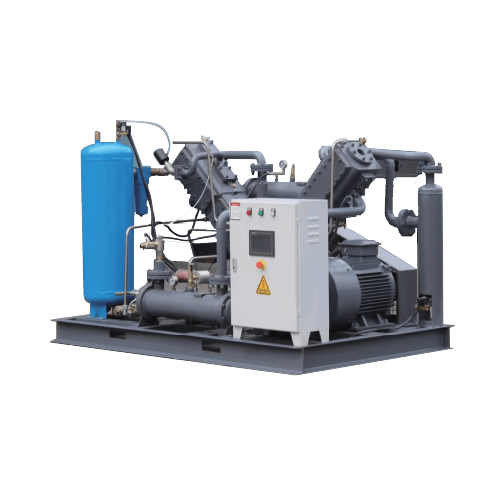
Capacity: Large centralized systems ranging from 50 HP to 300+ HP (37 kW to 250+ kW), often set up in multi-compressor configurations managed by a master central controller.
-
Essential Downstream Equipment:
-
Desiccant Air Dryers: Achieves pressure dew points of $-40^\circ\text{C}$ for paint lines to guarantee zero moisture condensation.
-
Dust & Oil-Removal Filter Banks: Multi-stage filtration to maintain strict clean-room standards.
-
Large Air Storage Receivers: Buffers high-volume pulse demands from heavy pneumatic machinery.
3. Comparison Summary
| Feature |
Automotive Repair Shop |
Automotive Manufacturing Plant |
| Air Demand |
Intermittent to moderate flow |
High volume, continuous 24/7 flow |
| Power Range |
7.5 – 30 HP (5.5 – 22 kW) |
50 – 300+ HP (37 – 250+ kW) |
| Oil Quality Standard |
Standard oil-injected with fine filtration |
ISO Class 0 Oil-Free (Paint & Precision) / Oil-Injected (Assembly) |
| Air Dryer Type |
Refrigerated Air Dryer |
Desiccant Dryer (Paint line) / Refrigerated Dryer (Plant air) |
| Primary System Goal |
Quiet operation, low footprint, clean paint supply |
Energy efficiency (VSD), 100% uptime, strict air purity |